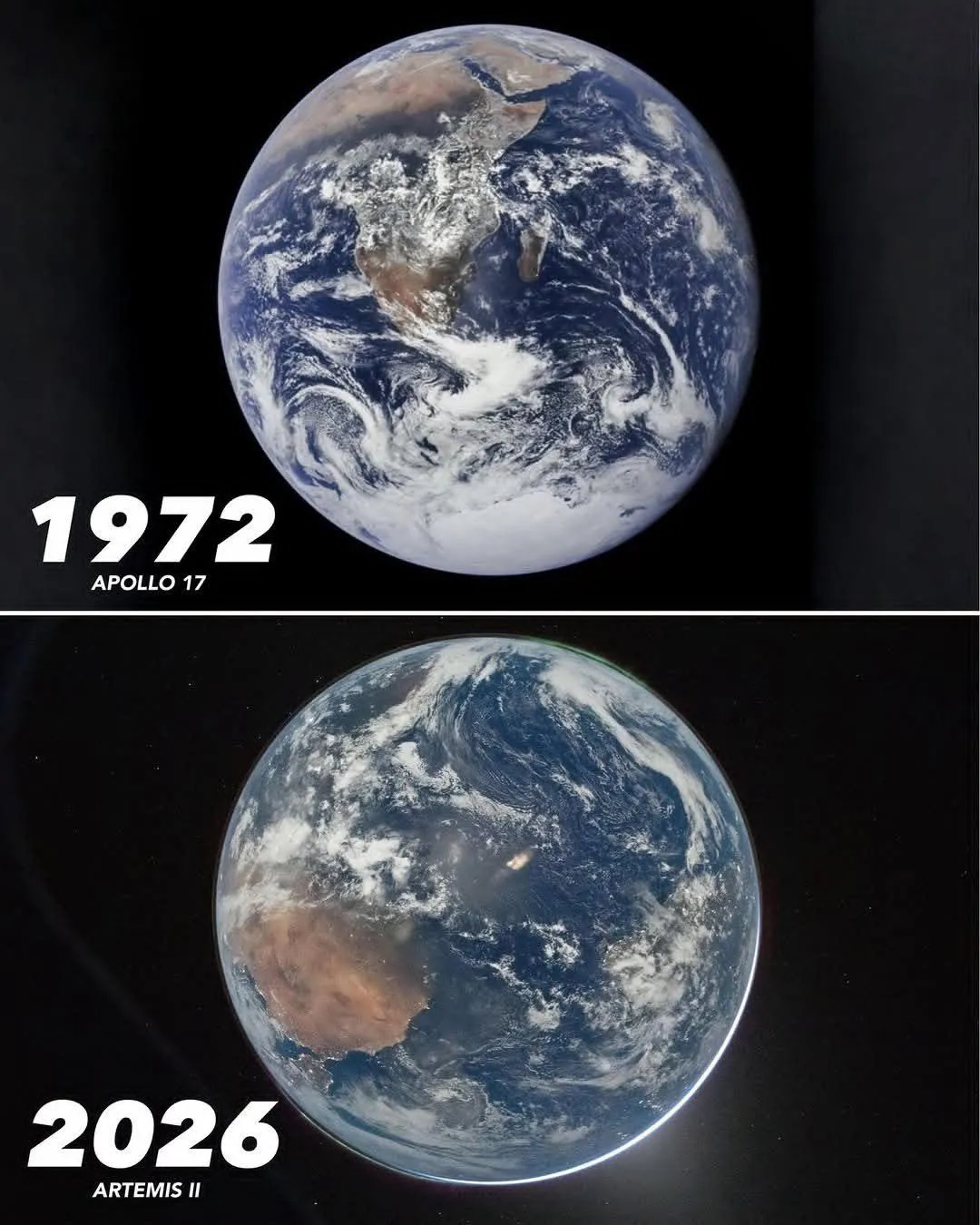
The picture above, named The Blue Marble, was taken by the Apollo 17 mission in 1972, the last of the Apollo missions. The picture below, called Hello, World, was taken on April 4, 2026, by the Artemis II mission currently on its way to the moon.
But for some reason, nobody is excited.
I wasn’t yet born when the original Apollo program took place. All I have are videos and articles from back then to see how people felt about it. There is television footage of people gathered around the launchpad to view the launch in awe. There are records of people listening to the launch and mission communication on their radios. Yet today, nobody seems to care. Even I learned about the mission two days after it started.
I think many people don’t understand the implication. Sure, we’ve already as a species gone and come back from the moon, but it’s still a big deal. There’s reason it took 57 years to visit the giant ball of cheese in the sky once more.
During the Apollo missions from 1969 to 1972, they had to wait for astronauts to return to retrieve the film and pictures. This time, the entire mission is being live streamed on YouTube. There are cameras inside the shuttle. There are cameras outside the shuttle looking into the void of space. Back then they used expensive modified Hasselblad cameras with custom-made film. This time, they used a consumer-grade Nikon camera. The amount of technological progress in the last few decades is hard to fathom without contexts like these.
Yet people don’t care.
Many people might look at the images and ask, “What’s the big deal? It’s just an image of Earth. I can do a Google search and find 200 of those.” But images of Earth aren’t easy to come by, especially true ones. Most images we see online and otherwise are composites of sectional images taken by satellites. You can’t take a full image of the Earth unless you’re far enough away, which is why this image and the mission are such a big deal.
But I guess the current war in Iran and the global economy take precedence over this accomplishment of human will and ingenuity.